
The Empathic God (Part 1)
Does our theology make sense of shame, guilt, and trauma?

“Important and central to the experience of trauma is that an excess of death remains in life in the aftermath. Trauma is not the wound that is healed by time. Fragments of the violent experience that caused trauma, remnants of death, remain and return from the past to disturb the present. An understanding of salvation that is relevant to those experiencing traumatic suffering must therefore account for the remainder of death.” - Frank Woggon1
As a contextual theologian, I have been haunted for two decades by a deep question: “Does the theology I hold and teach actually make sense of the pain in people’s lives, or is it merely a band-aid, a distraction to help them keep going?” This is a question born out of the weight of pastoral responsibility while sitting with family members mourning a tragic death, or a young father diagnosed with a rare cancer, or listening to the stories of the exploited and abused.
How does the gospel bring good news into this pain? What good news could I offer those who were saved but still lived within the valley of death? What good news could I provide victims of unimaginable suffering and exploitation, knowing that death would be present every day of their lives?
Unfortunately, too often we reduce or misunderstand the nature of the gospel and the work of Jesus. The result is unsatisfactory answers to the question of pain and suffering. Many times, the answers we end up with are some variations of these:
If, despite your pain and suffering, you give your life to Jesus, your pain will be over one day, and you will go to heaven
The whole world is broken because we are sinful. You were born broken and immoral, and we all share responsibility for the pain in this world as the consequences of our sin. Even if you didn’t do something to directly cause this suffering, we all deserve to suffer because of our sinfulness. But God decided to pour out the worst of that suffering on Jesus on the cross, so that you can be free from your guilt and be forgiven. You may not be healed, and bad stuff is going to happen, but at least you are forgiven.
We can’t see how, but this suffering you are enduring is all part of God’s plan. Maybe God is trying to teach you something. The good news is that you can have faith that, although this is awful, it might one day take on another meaning. One day, you might understand why you needed to suffer.
The spiraling doom you are feeling about the state of the world is all necessary for God to fix things. Everything is going to get worse; we call it the apocalypse! But those who believe in Jesus will escape the worst of the trials to come (that’s the rapture), and we will be with God watching the world descend into madness, until Jesus comes and brings redemptive retribution to the world and fixes things.
Personally and pastorally, I confess, I find little help in those beliefs. Thankfully, the gospel is far larger than those answers would offer, and the work of God extends beyond an understanding of atonement that merely removes guilt and allows us to escape the wrath of an angry God. To that end, I absolutely love the book The Empathic God by Dr. Frank Woggon. This is a book that actively seeks an articulation of the gospel that makes sense of the life and ministry of Jesus and the nature of God revealed in the fullness of the Christ event.
As a chaplain, director of a clinical pastoral education program, and ordained minister, Frank wrote this book in an effort to create a clinical theology of atonement, one that could serve his context and the deep questions of pain he encountered daily. In particular, Frank was driven to find a gospel that wasn’t centered on the need for God’s redemptive violence. In the preface of the book, he offers this poignant moment.
I remember being paged to the hospital one evening in May 2020, after seven people had been shot during protests, to support family members of victims and anxious hospital staff who were frightened, angry, and divided about the events in our community. (Louisville, KY) The human condition showed up unmistakably fragile, fragmented, and in need of healing, restoration, and reconciliation. In light of racially motivated violence that we witnessed in the news and on our streets, the notion that violence could be ultimately redemptive and heal the human condition seemed incredulous..2
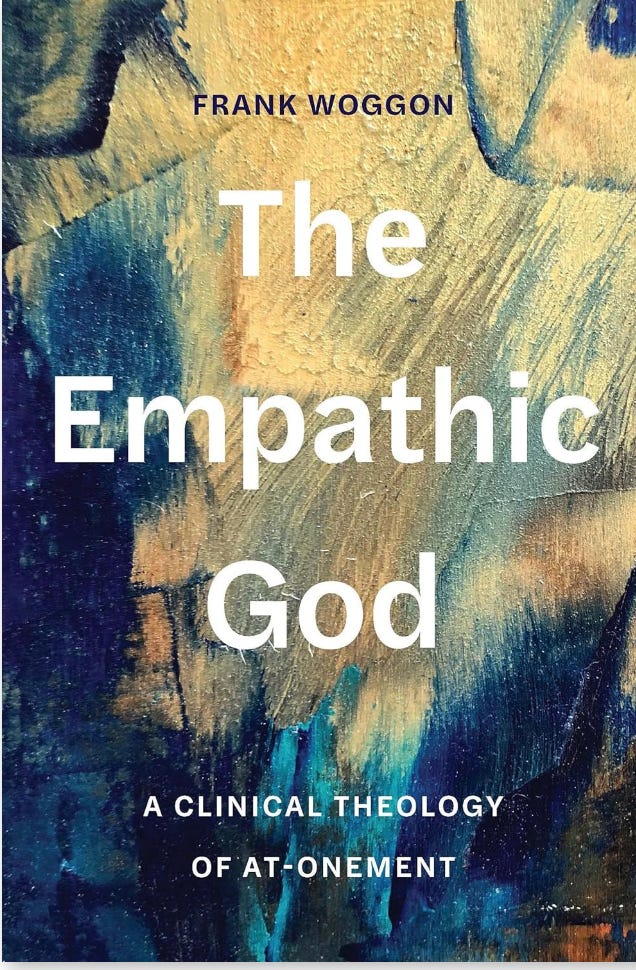
What hope does an Empathic God offer for our pain?
What if our theology of salvation offered us insight into and hope for our lived experiences of pain and moved us into healing, now, in this life? What if our understanding of God made sense of the incarnation and the fullness of the Jesus event so that in the compassion, empathy, and presence of God in the daily pain of his people, we found salvation? What if, as a spiritual caregiver, you had good news that led to healing and reconciliation for those fragmented by violence and trauma? This is the work that Frank undertakes in the book, offering a theology of at-onement that can provide hope and healing for the broken human condition.
“I used the word at-onement as a clinical-theological construct that refers to the empathic process that supports the flourishing of life by functioning to restore personal and relational wholeness in individuals and communities. Such wholeness, I contend, is the essence of salvation.”3
The empathic God revealed in the life of Jesus is a God who understands and is seeking to heal the remnants of death that show up daily in our shame, guilt, trauma, relational brokenness, and experience of violence. This is the goodness of the gospel, that God in flesh came to live and experience our lives, as an act of solidarity, witness, compassion, and ultimately redemptive empathy.
I would argue that is the nature of cruciformity, not that Jesus absorbed the wrath of God to stave off our punishment, but that God absorbed the violence, trauma, and destruction of humanity, and redeemed it through sacrificial love that all might be reborn into resurrected life. In this gospel, there is much to offer our pain and suffering.
Over the following few articles, I will explore The Empathic God and the clinical at-onement theology it offers. I will journey with Frank through his exploration of guilt and shame, empathy, and the empathic praxis of spiritual care. As a bonus, I am interviewing Frank later this week for the podcast! So, if you have questions about The Empathic God you want me to ask Frank, or questions about pain, suffering, and a clinical theology of at-onement, leave a comment or send me a message.
Frank Woggon, The Empathic God, p. 53
Ibid, preface xi
Ibid, p.2