
What about polygamy? (A Case Study in Contextual Sexual Ethics)
Cruciform Sexuality Part 3

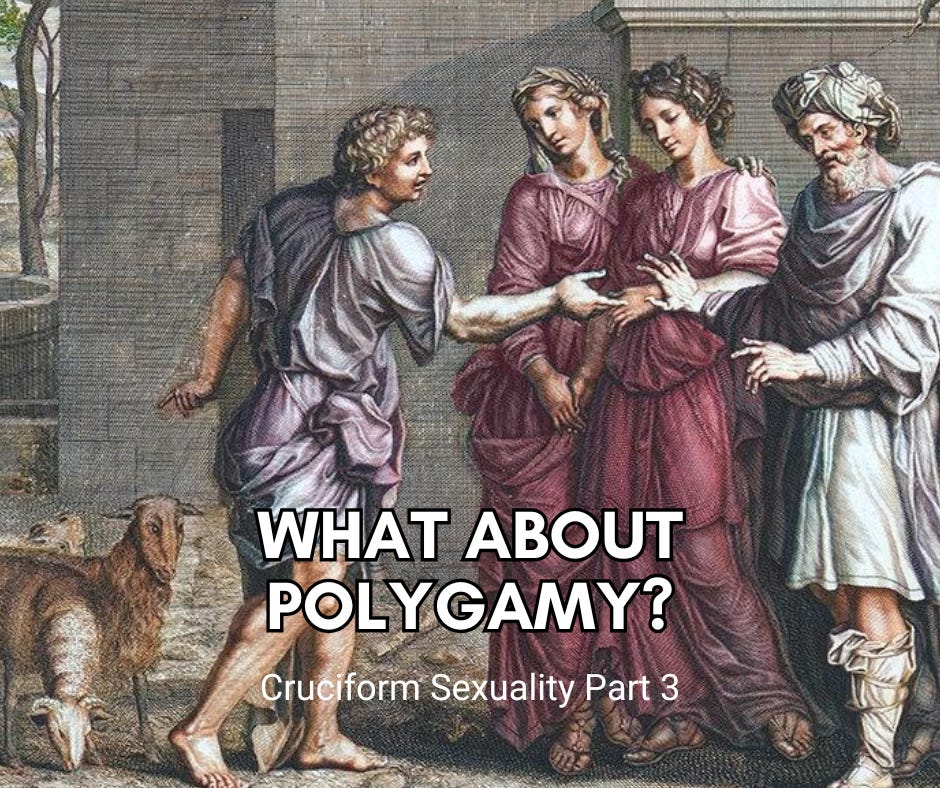
Have you ever encountered a Christian ethic that is pro-polygamy?
This is an interesting consideration, because for Christians who identify as “biblical” (I allow you to define that for yourself), there is a strong argument from scripture that polygamy is, at a minimum, tolerable if not entirely acceptable or even desirable. One could make a biblical argument that a sexual ethic that reserves sexual relationships for marriage allows for sexual relationships within plural marriage.
(And some are making that claim, such as this group called Biblical Families)
Yet, it is hard to find a mainstream American Christian ethicist or theologian who argues in favor of polygamy in any of its forms. A covenantal sexual relationship between more than a single husband and wife is considered outside the bounds of conventional Christian ethical behavior. It is so taboo that the reality of plural marriage might have been lost from the modern American imagination entirely if it weren’t for small numbers of Fundamentalist LDS groups, whose existence has been made widely known through books, TV series, documentaries, and reality TV shows exposing and exploring their existence.
For many of us, the questions of polygamy are closed. “Is polygamy acceptable for Christians? Should we be promoting or participating in polygamy? Is plural marriage God’s plan for marriage?” Ask every Christian you know, how long would it take you to find one who answers any of these questions with a yes? (I asked several myself, and they all gave me funny looks. That isn’t uncommon.)
And yet… the question of polygamy has been a significant ethical and missiological question for Christians for the majority of the past two thousand years. Why? It is a question because polygamy has commonly existed in both cultures in which Christians live and in those they encounter as they seek to evangelize the world.
Polygamy existed in numerous Ancient Near Eastern societies and was practiced in various forms by those in scripture, especially among the patriarchs of Israel. (i.e., Lamech, Abraham, Jacob, Elkanah, David, Solomon). There are numerous laws given to Israel regarding how to differentiate itself from its neighbors, and certainly, marriage and sexual ethics factor prominently in those laws.
But there is no law that forbids polygamy. Does that surprise you?
Interestingly, scripture’s approach to polygamy is to regulate it (Exodus 21:10, Deut. 21:15-17) and warn against its consequences (Deut. 17:17), but not to forbid it. You can argue that the narrative of scripture faithfully demonstrates the consequences of polygamy for those who participate in it (quite extensively, and in a host of contexts). But the calling of Israel out of this practice is far more subtle, compassionate, and focused on subverting the practice than on waging war against it.
Diverse Responses to Polygamy
Because of this approach in scripture, theologians and missionaries have often taken a similar approach to questions of polygamy as it has arisen.
St. Augustine wrote about polygamy in several places. In On Christian Doctrine in Four Books, he wrote that some forms of polygamy were ethically superior to some forms of monogamy. (Full text in footnote1) Here, polygamy is seen as a cultural concession, one whose use should be evaluated by the purpose of its existence and the manner in which it is carried out. Augustine argues that plural marriage free from lust and the selfish sexual use of one partner by another is superior to a single marriage where there is selfish sexual use. It is not merely the form of marriage, but the nature of it that matters to Augustine.
Bishop John Colenso, serving as a missionary in South Africa in the 19th Century, wrote extensively about polygamy because of his context. Pushing back against strict rules about polygamist men needing to divorce all but one wife in order to convert, Colenso believed such a practice would create moral harm. There were justice issues for families that must be considered when handling polygamy, and to ignore these issues was to violate the love and ethics of Christ. 2
In my own denomination, the handling of polygamy among African Nazarenes is still a local pastoral and regional question. Even with a clear statement on human sexuality that defines God’s plan for marriage as between one man and one woman, the lived reality of ministry in and among polygamists has resulted in significant debate. Should polygamists divorce all but one spouse? Can they be received into full membership in the church? Can they serve in church leadership? These questions have been widely discussed in local contexts and as a global region. (Excellent summation here)
These examples point to the complexity of Christian sexual ethics. Sexual ethics are not only about laying out an idealized ethic of sexuality, but about navigating the human complexities of sexuality that show up across our social structures. We want sexual ethics to be simple, but alas, they are always complicated. This is why we need contextual sexual ethics.
Contextual Sexual Ethics
For some, the term contextual sexual ethics is cringeworthy. Contextualizing our sexual ethics is seen as a concession to the culture, a backsliding of Christian tradition, and unorthodox. A brief survey of Christian theological and ethical responses to polygamy, however, shows that the church has long wrestled with the translatability of Christianity to different cultures.
Sexual ethics have always been part of this cultural dialogue because sex ethics are not merely rules about sex; they are part of the fabric that sustains our social worlds. Missionaries encountering polygamist cultures recognize the questions of justice, economics, gender, familial ties, and social support that are incorporated into polygamist structures.
As we work to understand the cultures that shape our own ethics, we would do well to recognize how our sexual ethics are tied to belonging, identity, economics, justice, and human flourishing. As we gain insight into these connections, we can move on to questions of adaptability, concession, subversion, and redemption that all Christians must ask of their culture.
We can also form an ethical lens that will serve us when new questions arise. (This was the work that Hank Spaulding and I embarked upon in our conversation about the rise of A.I. and its impact on sexuality and human flourishing.) This is why I am proposing cruciformity as an ethical/theological lens for sexuality. It invites us into a posture of humility, healing, participation in Christ, and redemption that can guide our way through the difficult landscape of human sexuality.
For, if it was possible for one man to use many wives with chastity, it is possible for another to use one wife with lust. And I look with greater approval on the man who uses the fruitfulness of many wives for the sake of an ulterior object, than on the man who enjoys the body of one wife for its own sake. For in the former case, the man aims at a useful object suited to the circumstances of the times; in the latter case, he gratifies a lust which is engrossed in temporal enjoyments. And those men to whom the apostle permitted, as a matter of indulgence, to have one wife because of their incontinence, were less near to God than those who, though they had each of them numerous wives, yet just as a wise man uses food and drink only for the sake of bodily health, used marriage only for the sake of offspring.” https://www.sermonindex.net/books/Zya-p6ZWpCUkGpZp/contents/141
https://anglicanhistory.org/africa/colenso/polygamy1855.html
I thought it was funny that this idea had a resurgence and rebranding about 20 years ago. Young people claimed to be polyamorous and the word throuple entered our zeitgeist. One can't be in an open marriage, that's what your parents’ generation said. You can't be swingers that's what your grandparents’ generation said. Polygamy reeks of misogyny so that was out. A new generation seeks to relearn the same lessons of every generation before it. Wise old King Solome said it was unwise to have more than one wife and he should know, he had a thousand. Polyamorous sounds great. It means “all the love.” What we really want is all the love of one individual. You could rail against the sin of jealousy but that seems to be hardwired in our view of spouses. I'm sure you could find some that have happiness in this idea but by and large most will be miserable. My wife jokes that she needs a wife but I am quite sure she doesn't mean for me. She wants someone to cook. clean and take care of paperwork. I believe my wife's opinion of having two husbands is that would be one and a half too many men to take care of. Having said I don’t think it’s wise, what do you think about letting the issue be between the individual and God?
I think maybe expanding cruciformity to include the full Christological triad (my phrase) of incarnation, crucifixion, and resurrection à la Bonhoeffer could be helpful in these discussions. Good stuff here though.